
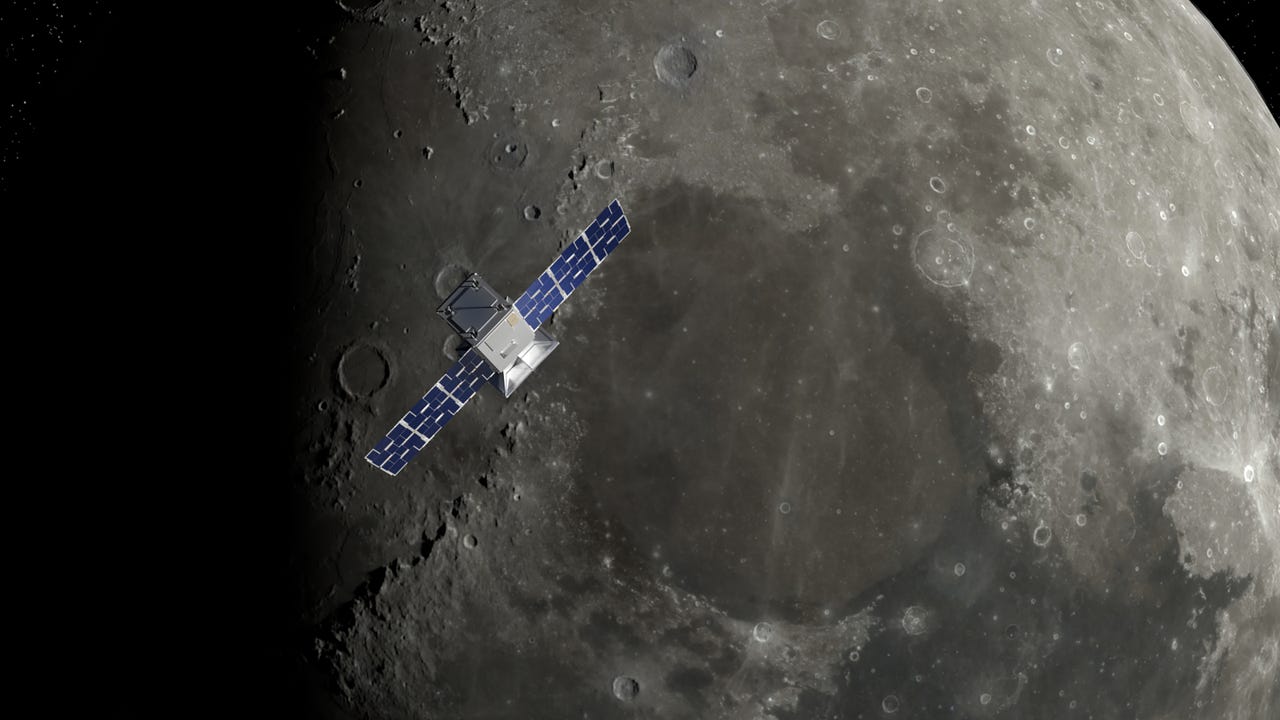
CAPSTONE over the lunar North Pole.
Image: Illustration by NASA/Daniel RutterAs NASA gears up for the Artemis I launch on Wednesday morning, a small cube satellite has reached its intended orbit at the Moon, playing a small but important role in the return to the Moon.
NASA's Artemis 1 mission management team on Sunday gave the all clear for the giant Space Launch System (SLS) rocket and Orion spacecraft to proceed with the next launch attempt on Wednesday, November 16. NASA has a two-hour launch window at 1:04 AM EST Wednesday, and a very long to-do list before it can get the giant rocket launched.
Innovation
- I tried Apple Vision Pro and it's far ahead of where I expected
- This tiny satellite communicator is packed full of features and peace of mind
- How to use ChatGPT: Everything you need to know
- These are my 5 favorite AI tools for work
Meanwhile, NASA confirmed its 55-pound CubeSat, which is part of the Capstone (Cislunar Autonomous Positioning System Technology Operations and Navigation Experiment) mission, reached its near-rectilinear halo orbit (NRHO) at 7:39 PM EST on Sunday evening after its thrusters assisted with last-minute manoeuvring into that special orbit. NASA launched the Capstone mission in late June on a Rocket Lab Lunar Photon, but soon after the agency lost contact with it.
The Capstone mission's NRHO orbit is the path NASA wants its future Gateway space station to track in support of deep-space exploration.
Gateway will be 'human-tended' and will support future Artemis missions, which will revive human-led, long-term exploration of the Moon and deep space.
Also: What is Artemis? Everything you need to know about NASA's new moon mission
NASA notes that Capstone is the first spacecraft to fly an NRHO, and the first CubeSat to operate at the Moon.
NASA selected NRHO to support Artemis missions over two other options. The first alternative, low lunar orbit, tracks close to the lunar surface and completes its orbit every two hours, but requires more propellant ¨C due to the pull of Moon's gravity ¨C than is required to last 15 years. A distant retrograde orbit, on the other hand, is more fuel-efficient and circles the Moon once a fortnight, but the extra distance would make it harder for Gateway to get to the Moon's surface.
NRHO is a compromise between the two orbits, giving closer access to the surface and better fuel efficiency.
"Hanging almost like a necklace from the Moon, NRHO is a one-week orbit that is balanced between the Earth's and Moon's gravity," NASA explains.
NRHO will also give Gateway a continuous line of sight of Earth, enabling uninterrupted communication between Earth and the Moon.
Over the next week, Capstone will perform two more clean-up manoeuvres to refine its orbit. Then NASA will review data to confirm that it remains in NRHO.
Space
-
What is Artemis? Everything you need to know about NASA's new moon mission
-
NASA has solved the mystery of Voyager 1's strange data transmissions
-
NASA's new tiny, high-powered laser could find water on the Moon
-
NASA is blazing an inspirational trail. We need to make sure everyone can follow it