
If you're still managing inventory in spreadsheets (or worse, on paper), you already know how quickly things fall apart. One stockout during a busy sales week can cost you thousands. A single miscounted stock keeping unit, or SKU, can snowball into a logistics nightmare that takes days to untangle.
The good news is that inventory management software has come a long way. Whether you're running a small retail operation, scaling a direct-to-consumer, or DTC, brand, or coordinating production across multiple warehouses, there's a tool built for your specific situation. I've tested the top contenders to help you pick the right one.
Get more in-depth tech coverage: Add us as a preferred Google source on Chrome and Chromium browsers.
Best personal data removal service deals of the week
-
Incogni - Exclusive Deal: 55% Off Incogni Individual Annual Plan With Code "" :$162 (save $198)
What is the best inventory management software right now?
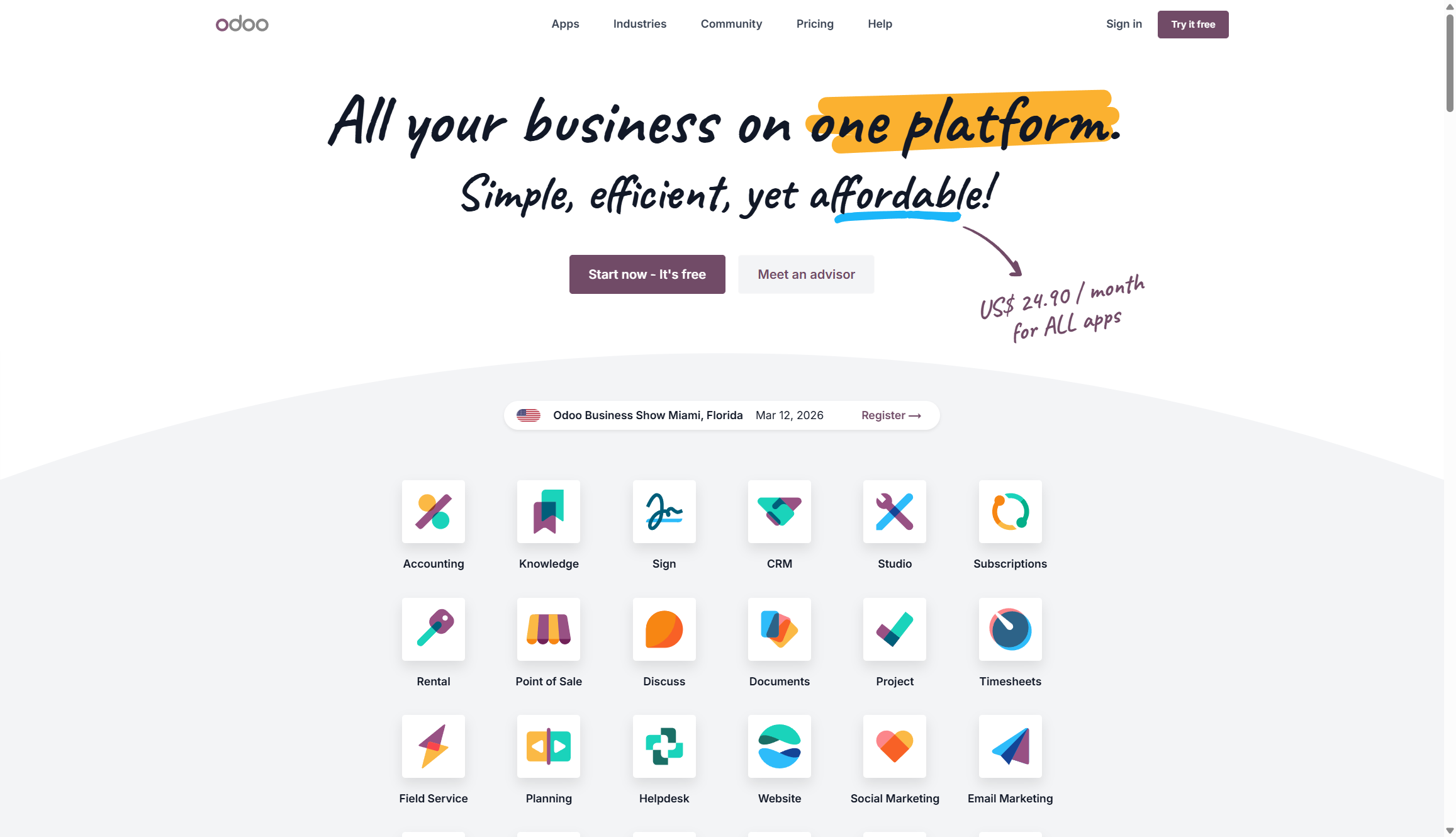
My top pick is Odoo. It has an inventory app that's completely free as a standalone module with unlimited users, packing in real-time tracking, multi-warehouse support, barcode scanning, and automated replenishment. What really sold me is how naturally it connects with the rest of Odoo's ERP suite, so you can bolt on sales, purchasing, accounting, and manufacturing as your needs evolve without switching platforms.
Also: The best ERP software
The best inventory management software of 2026
Odoo stands out from the rest of the ERP crowd immediately because of its pricing. The standalone Inventory app is free forever, with unlimited users. The platform runs on a double-entry inventory system that automatically tracks every stock movement without manual inputs. This cuts down on the human errors that tend to pile up in spreadsheet-heavy operations.
But the real power shows up when you connect Inventory to the rest of Odoo's ecosystem. Sales orders adjust stock levels automatically. Reorder rules trigger purchase orders when you're running low. You can trace products across warehouses using serial numbers, lot numbers, or barcodes, and the system handles advanced routing like drop-shipping and cross-docking without any extra configuration.
Here's where it gets tricky, though. Once you add a second app (say, Accounting or Sales), you'll jump to the Standard plan at roughly $31.10 per user per month billed annually. The Custom plan runs about $46.70 per user per month and unlocks API access, Odoo Studio, and multi-company support. For a 10-person team using multiple modules, that adds up fast.
Still, Odoo's open-source foundation means there's a massive community building custom modules and integrations. If you want to start lean and grow into a full ERP without ripping out your inventory system later, it's hard to beat. Just budget some time for the learning curve, because this isn't a plug-and-play tool.
Odoo features: Real-time stock tracking | Multi-warehouse management | Automated replenishment | Barcode scanning | Double-entry inventory | Drop-shipping support | Batch and serial tracking
- Free single-app plan available
- Seamless ERP integration
- Highly customizable workflows
- Costs escalate with added apps
- Steeper learning curve
- Limited Mac support for self-hosted
Odoo
Best inventory management software overall
Odoo stands out from the rest of the ERP crowd immediately because of its pricing. The standalone Inventory app is free forever, with unlimited users. The platform runs on a double-entry inventory system that automatically tracks every stock movement without manual inputs. This cuts down on the human errors that tend to pile up in spreadsheet-heavy operations.
But the real power shows up when you connect Inventory to the rest of Odoo's ecosystem. Sales orders adjust stock levels automatically. Reorder rules trigger purchase orders when you're running low. You can trace products across warehouses using serial numbers, lot numbers, or barcodes, and the system handles advanced routing like drop-shipping and cross-docking without any extra configuration.
Here's where it gets tricky, though. Once you add a second app (say, Accounting or Sales), you'll jump to the Standard plan at roughly $31.10 per user per month billed annually. The Custom plan runs about $46.70 per user per month and unlocks API access, Odoo Studio, and multi-company support. For a 10-person team using multiple modules, that adds up fast.
Still, Odoo's open-source foundation means there's a massive community building custom modules and integrations. If you want to start lean and grow into a full ERP without ripping out your inventory system later, it's hard to beat. Just budget some time for the learning curve, because this isn't a plug-and-play tool.
Odoo features: Real-time stock tracking | Multi-warehouse management | Automated replenishment | Barcode scanning | Double-entry inventory | Drop-shipping support | Batch and serial tracking
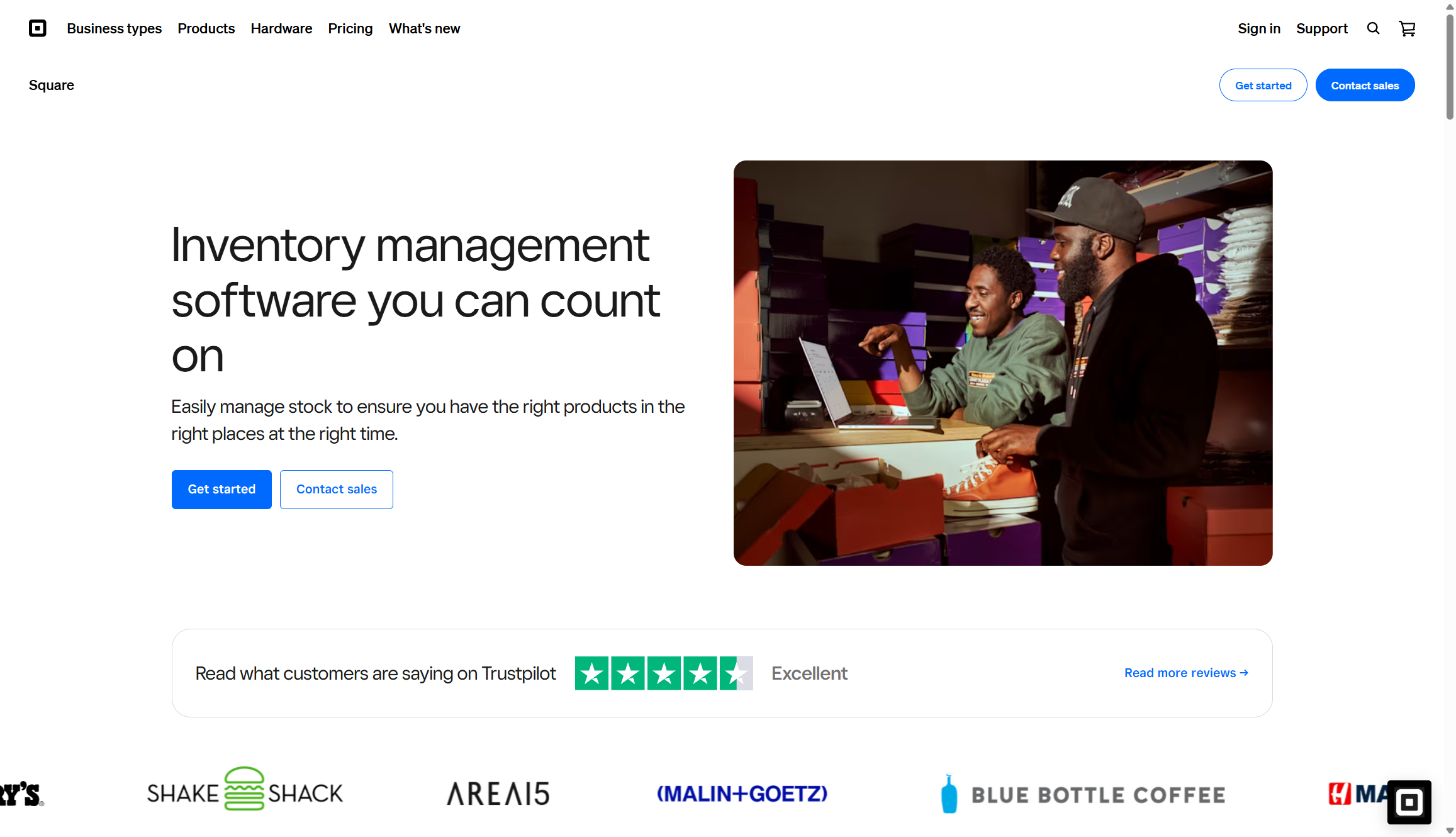
Square isn't the first name that comes to mind for inventory management, but it probably should be for small retailers. Basic stock tracking is free with any Square account. You get real-time updates as sales come through, daily low-stock email alerts, and automatic syncing between your in-store POS and online channels.
The paid plans are where things get more useful. Square's Plus tier at $49 per month per location adds barcode label printing, vendor profiles, purchase order management, COGS reports, and multi-location inventory transfers. Premium at $149 per month per location layers on advanced reporting and deeper operational tools. If you're already processing payments through Square, there's real convenience in keeping everything under one roof.
I should be upfront, though: Square's inventory capabilities are basic compared to dedicated platforms. There's no manufacturing support, no advanced warehouse management, and no deep supply chain analytics. It's built for retailers selling finished goods, not businesses managing raw materials or production workflows.
But for what it does, it does it well. Setup is fast, the interface is dead simple, and stock levels update in real time as transactions flow through. If your operation is straightforward and you value ease of use over feature depth, Square is a smart starting point.
Square features: Real-time stock tracking | Low-stock alerts | Barcode label printing | Multi-location transfers | Purchase orders | COGS reporting | Omnichannel sync
- Free basic inventory tools
- Seamless POS integration
- Clean, beginner-friendly interface
- Limited advanced features
- Per-location pricing adds up
- Not built for complex supply chains
Square
Best for retail stores with POS-integrated inventory
Square isn't the first name that comes to mind for inventory management, but it probably should be for small retailers. Basic stock tracking is free with any Square account. You get real-time updates as sales come through, daily low-stock email alerts, and automatic syncing between your in-store POS and online channels.
The paid plans are where things get more useful. Square's Plus tier at $49 per month per location adds barcode label printing, vendor profiles, purchase order management, COGS reports, and multi-location inventory transfers. Premium at $149 per month per location layers on advanced reporting and deeper operational tools. If you're already processing payments through Square, there's real convenience in keeping everything under one roof.
I should be upfront, though: Square's inventory capabilities are basic compared to dedicated platforms. There's no manufacturing support, no advanced warehouse management, and no deep supply chain analytics. It's built for retailers selling finished goods, not businesses managing raw materials or production workflows.
But for what it does, it does it well. Setup is fast, the interface is dead simple, and stock levels update in real time as transactions flow through. If your operation is straightforward and you value ease of use over feature depth, Square is a smart starting point.
Square features: Real-time stock tracking | Low-stock alerts | Barcode label printing | Multi-location transfers | Purchase orders | COGS reporting | Omnichannel sync
Katana is built specifically for manufacturers, and it shows. The visual production planning board is the highlight. It's a drag-and-drop interface that lets you prioritize work orders, assign tasks, and track progress without juggling multiple tools. I found it genuinely intuitive, more like a modern project management app than a traditional ERP.
There's now a free plan that supports up to 30 SKUs and three inventory locations, which is enough to test the platform with real data. The Core plan starts at $299 per month and opens up unlimited SKUs, unlimited users, and the full suite of production, purchasing, and order management features. Costs scale based on your number of locations and monthly sales orders, which keeps things proportional to your actual usage.
What I appreciate most is how Katana handles the link between raw materials and finished products. Your bill of materials connects directly to live stock levels, so you know instantly whether you have the components to fill an incoming order. The Shop Floor App puts barcode scanning, task lists, and real-time updates in your warehouse team's hands, replacing printed work orders that gather dust on a clipboard.
The catch? Katana doesn't do invoicing, so you'll need QuickBooks, Xero, or another accounting tool plugged in. Some long-time users have also flagged frustration with pricing changes as the company has scaled. But for small manufacturers who want production-aware inventory management without enterprise-level complexity, Katana is one of the strongest options I've tested.